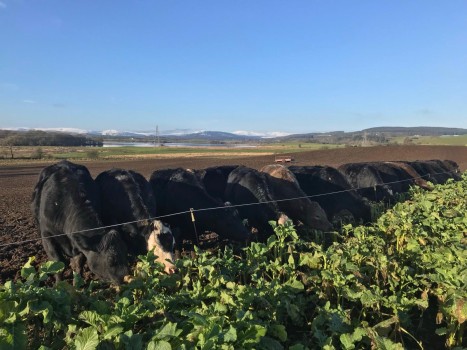
Fodder Crop Requirements
The table below helps estimate how much fodder crop is required for different classes of stock. It gives a guide to how many animals can be fed per hectare over a 90-day period, and the likely time to full utilisation.
| Crop | DM yield (t/ha) | Sheep | Cattle | Days until utilisation | ||
|---|---|---|---|---|---|---|
| Ewes | Lambs | Cows | Stores | |||
| Kale | 9 | 96 | 119 | 6 | 14 | 154–210 |
| Rape/Kale Hybrid | 3.5 | 37 | 46 | 3 | 5 | 70–110 |
| Stubble Turnip | 4 | 43 | 53 | 3 | 6 | 56–100 |
| Swedes | 9 | 96 | 119 | 4 | 14 | 170–220 |
| Fodder Beet | 17 | 181 | 225 | 12 | 26 | 175–210 |
Based on 70% of diet from crop and 25% wastage. Intakes assumed: ewes (70kg) 1.6% LW, lambs (30kg) 3% LW, cows (750kg) and stores (350kg) 2.2% LW.
Example:
Sample weight = 7kg
7 × 10,000 = 70,000kg FW/ha
× 15% DM = 10,500kg DM/ha = 10.5 t DM/ha
Feed Allocation
The DM yields shown are guide values taken from book figures. Actual yield will vary with variety, soil, climate, and crop management. To plan feeding accurately, a simple field assessment should be carried out. This allows calculation of DM yield and daily allocation, which in turn determines how far to move the fence each day.
Measuring DM Yield – Quick Method
You will need:
- 1m² quadrat (or 3.54m pipe loop)
- Bag
- Shears or knife
- Hand scales
- Notebook & pen
Steps:
- Place the quadrat on a representative part of the field, avoiding headlands or poor patches.
- Harvest within the square:
- Roots – lift all roots & leaves, clean off soil.
- Leafy crops – cut 2–3cm above ground.
- Weigh the sample.
- Multiply weight by 10,000 = fresh weight/ha.
- Multiply by crop DM % ÷ 100 = DM/ha.
Using DM Yield
Once DM yield is known, stock requirements can be matched to available feed. This provides a practical guide to stocking rate, grazing duration, and fence movement. An example calculation for a 70kg ewe is shown below.
Calculating Daily Allocation (adapted from AHDB)
Using simple DM and daily allocation calculations shows how far to move the electric fence each day to achieve high utilisation.
| A | Total estimated intake (using 1.6% of liveweight) | 1.20kg DM/day |
| B | Crop inclusion of the diet (allowing 30% fibrous forage) | 70% |
| C | Daily requirement of forage (A × B) | 0.84kg DM |
| D | Number of animals grazed | 300 |
| E | Daily requirement of forage (C × D) | 252kg DM |
| F | Estimated crop yield (DM/m²) – crop yield as above, 10.5 tonnes @ 80% utilisation (1.05kg/m² × 0.8) | 0.84kg DM/m² |
| G | Total grazing area required/day (E ÷ F) | 300m² |
| H | Length of electric fence (feed face) | 150m |
| I | Width of fence moved per day (G ÷ H) | 2.00m/day |
Calculating Feed Budget (adapted from AHDB)
A feed budget can then be used to calculate the total area needed for the winter, as shown below for 70kg ewes.
| A | Total estimated intake (using 1.6% of liveweight) | 1.20kg DM/day |
| B | Crop inclusion of the diet (allowing 30% fibrous forage) | 70% |
| C | Daily requirement of forage (A × B) | 0.84kg DM |
| D | Feeding period | 120 days |
| E | Total DM requirement per animal (C × D) | 101kg DM |
| F | Total required for flock (e.g. 300 ewes × E ÷ 1,000) | 30.30t DM |
| G | Forage utilised yield (t DM/ha) – 10.5t @ 80% utilised | 8.40t DM |
| H | Forage area required for winter (F ÷ G) | 3.60ha |
Ensure an area of run-back is also budgeted for.